To determine whether lithium batteries have completely surpassed lead-acid batteries in data centers, let's first explore the history of battery technology.
Lithium Battery Overview: Lithium batteries refer to both lithium metal and lithium-ion batteries, though typically, when people refer to lithium batteries, they mean lithium-ion batteries. These batteries are characterized by their non-metallic lithium content and ability to support repeated charge and discharge cycles.
From the release of Sony's first commercial lithium-ion battery in 1991, to Huawei’s large-scale adoption of lithium batteries in communication base stations in 2009, and the explosion of the electric vehicle (EV) market in 2016, the global sales of lithium battery manufacturers have grown exponentially, with the top ten lithium battery manufacturers now approaching 90 GWh in sales.
As the energy density, safety performance, and cost of lithium-ion batteries have continued to improve, their application in sectors such as communications, power, electric vehicles, and data centers has expanded significantly. Lithium batteries are steadily moving toward becoming the mainstream energy solution of the future.
Why Use Lithium Batteries?
Lead-acid batteries have long dominated the telecommunications sector. However, they come with several drawbacks, including a short cycle life, large footprint, high weight-bearing requirements for equipment rooms, and environmental pollution during manufacturing. As a result, the global development of lead-acid batteries is in decline, with China explicitly discontinuing tenders for lead-acid batteries.
Lithium batteries offer inherent advantages, such as higher energy density, smaller footprint, and longer cycle life—features that lead-acid batteries do not possess. As the market share of lead-acid batteries shrinks rapidly, lithium battery adoption worldwide has surged, with almost all 5G base stations being equipped with lithium batteries. Similarly, large-scale adoption of lithium batteries in data centers is starting to take place among major international ISP customers. It is projected that within the next 3 to 5 years, the market share of lithium batteries will either match or exceed that of lead-acid batteries, and it has become widely accepted across industries that lithium batteries will dominate the future market.
Battery Technology Trends
3C Applications (Consumer Electronics): Cobalt-based batteries increase the charging voltage limit, thereby continuously improving energy density. After 2025, solid-state electrolytes could further enhance voltage, approaching the theoretical limit of 4.9V.
Power Applications (Electric Vehicles):
For high-end EVs: Nickel-cobalt-manganese (NCM) batteries are improving with higher nickel content and increased charging voltage, further boosting energy density. After reaching an 811 NCM ratio and 4.25V voltage, energy density gains become marginal. The future trend is toward solid-state batteries, expected to become commercially available post-2025.
For mid- and low-end EVs and buses: Lithium iron phosphate (LFP) technology is expected to take over.
Cycle Energy Storage: Lithium iron phosphate (LFP) batteries have reached near-theoretical limits in terms of material capacity (currently 155mAh/g), and voltage has plateaued. The focus is now on improving cycle life and safety. Sodium-ion batteries represent a potential future alternative due to their low raw material costs and compatibility with the existing lithium battery supply chain.
Short-Term Backup Power: Lithium iron phosphate (LFP) batteries, offering superior safety, lifespan, and cost-effectiveness, are evolving toward enhanced power density and safety characteristics. Future developments may include hybrid battery and capacitor solutions.
Recommended Lithium Battery Material for Data Centers: Lithium Iron Phosphate ("Goodenough")
In 2019, the Nobel Prize in Chemistry was awarded to John B. Goodenough, M. Stanley Whittingham, and Akira Yoshino for their contributions to the development of lithium-ion batteries. Notably, Goodenough became the oldest Nobel laureate in history, and his life’s work on lithium batteries, particularly his contribution to the development of lithium iron phosphate (LFP), is highly regarded. LFP is widely considered one of the safest and most environmentally friendly lithium-ion battery materials.
For data centers and communication base stations, lithium iron phosphate (LFP) has proven to be "Goodenough" for its reliability, safety, and efficiency.
Why Choose Lithium Iron Phosphate?
Lithium-ion batteries in the market today generally fall into four categories: lithium cobalt oxide (LCO), lithium manganese oxide (LMO), lithium iron phosphate (LFP), and NCM. LCO is primarily used in mobile phone batteries, LMO in electric bicycle batteries, LFP in large-scale energy storage and buses, and NCM in household and commercial electric vehicle batteries.
In data center applications, both LFP and NCM are widely used. However, LFP offers superior reliability, while NCM batteries provide higher energy density.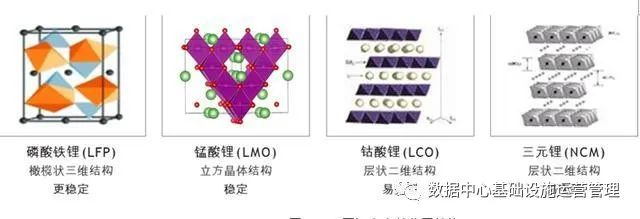
Structural Stability: LFP has a more stable molecular structure compared to NCM and LCO, which are layered structures. The two-dimensional structure of NCM and LCO is more prone to collapse, making LFP more stable.
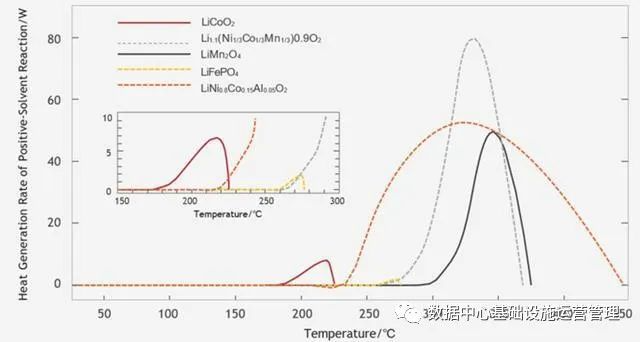
Thermal Stability: LFP has excellent high-temperature stability, with a minimal heat generation rate (approximately 1W at peak). In contrast, NCM can produce rapid heat buildup (up to 80W/min), which can lead to explosive combustion.
Thermal Runaway Behavior: LFP does not produce oxygen during thermal runaway, unlike NCM, LCO, and manganese batteries, which can further accelerate fire risks. LFP requires a much higher temperature to reach thermal runaway, making it safer.
Challenges in Lithium Battery Application in Data Centers
Cost: While lithium batteries have become more affordable due to their widespread use in electric vehicles, industrial energy storage, and other sectors, lead-acid battery prices remain volatile. However, as lithium battery costs continue to decrease, they are expected to become more competitive in data center applications.
Reliability: Despite the widespread adoption of lithium batteries, incidents such as overheating and fires have occurred in various applications, from electric vehicles to mobile phones. In data centers, the reliability of batteries is paramount as any fire could result in catastrophic losses.
Ensuring Lithium Battery Safety in Data Centers
Root Causes of Lithium Battery Failures: Overheating and overcharging can trigger a series of exothermic reactions inside the battery, leading to thermal runaway and the release of flammable gases, resulting in combustion.
Lithium Battery Safety Measures: Following high-profile incidents like the Samsung Note 7 and Tesla fires, lithium battery safety must be rigorously designed. Battery safety must be ensured across multiple layers, including the cell, battery pack (PACK), battery management system (BMS), and cloud computing/big data systems.
Battery Cell Material Selection: LFP is preferred due to its higher thermal runaway threshold, slower heat generation rate, and lower total heat output.
Structural Design: Mechanical structures that prevent overheating and mitigate the risk of thermal runaway.
Functional Coatings: Coatings that prevent internal short circuits during failure.
Pack Safety Design: Multi-layered protective mechanisms to ensure that the battery's safety remains intact under various stress conditions.




































