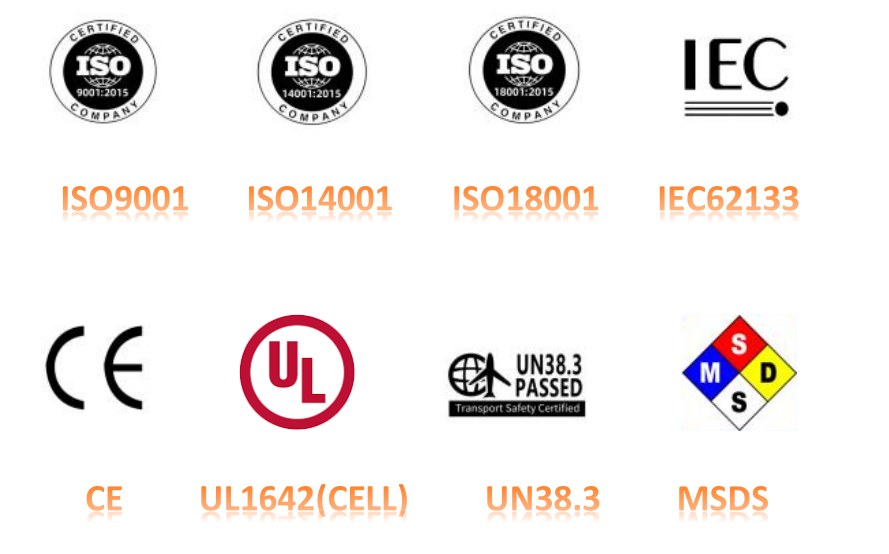
Check details in ELB certification center.
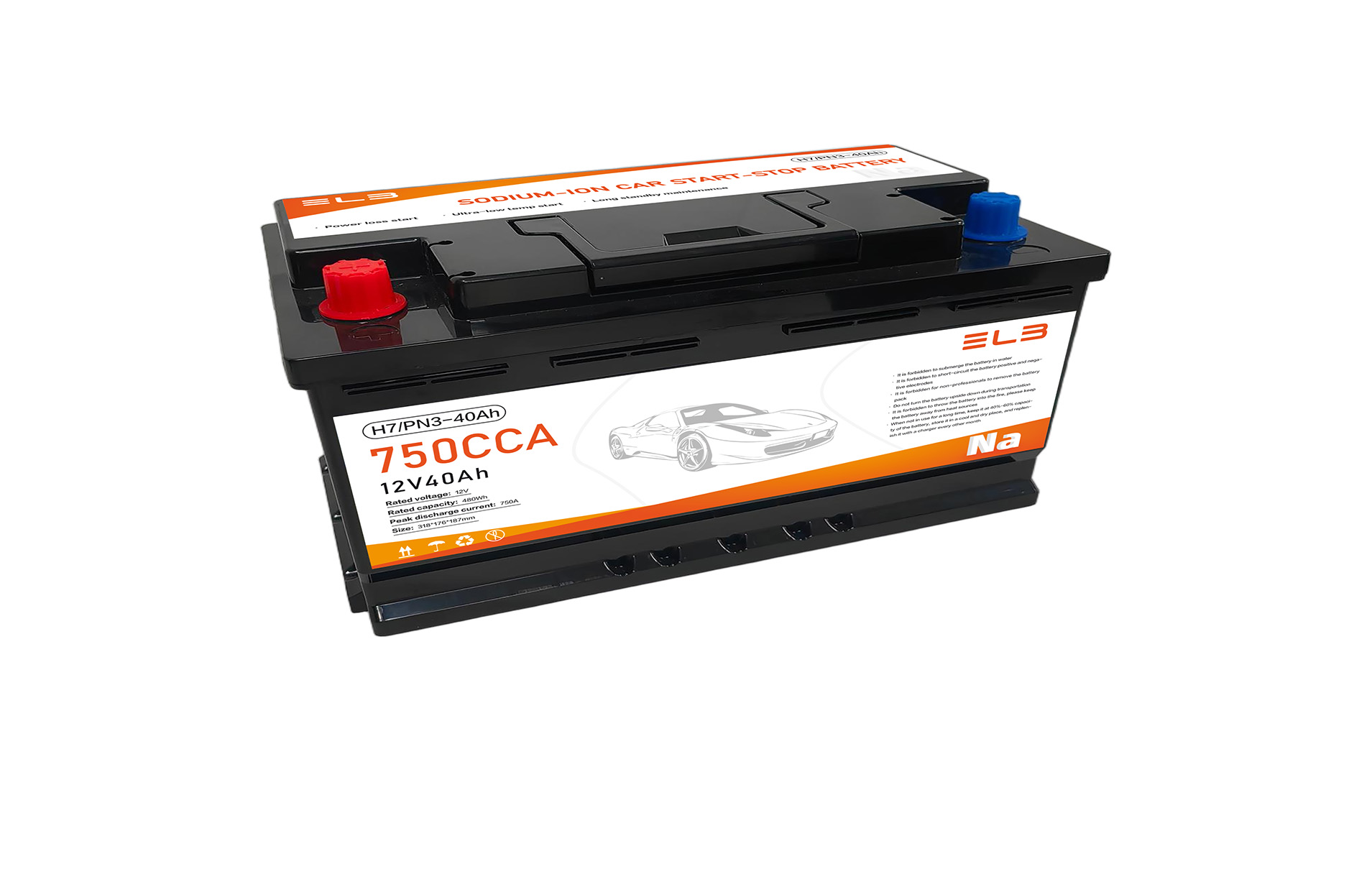
Exceptional Cycle Life:?≥5000 cycles at 0.5C rate and 100% Depth of Discharge (DOD), ensuring long-term durability and value.
Expansive Operating Range:?Functions reliably across an extreme temperature spectrum from -40°C to 80°C.
Superior Cold-Temperature Performance:?Maintains over 80% capacity retention at -20°C for dependable power in freezing conditions.
High Cranking Power: Delivers 750A of starting current, guaranteeing reliable ignition for engines of cars, trucks, and vans.
Rapid Charging Capability:?Supports high-rate charging, significantly reducing downtime and improving operational efficiency.
| Performance comparison of different types of battery | |||
| Comparison Item | Lead acid battery | LiFePO4 battery | Sodium-ion battery |
| Working Voltage | 10.5V~16V | 10V~14.6V | 8V~14.4V |
| Energy density | 30-50Wh/Kg | 120-200Wh/Kg | 100-120Wh/Kg |
| Cycle life | 150~300cycles | >2500cycles | 1500-2500cycles |
| Charging performance | 6-8h | Low-Temp Charging: Sustained 1C-2C | Sustained 10C (80% charge in 15 min) |
| Discharging?performance | Poor | Normal temperature/High temperature: Good Low temperature: Poor | Temperature range: Excellent (maximum support 25C discharging) |
| Safety?performance | ?Good | Excellent | ?Good |
| High-temperature performance | Excellent | ?Good | Excellent |
| Low-temperature performance | Excellent | Average | Best |
| Environmental friendliness | Average | Average | Best |
| Cost | 0.3-0.5 RMB/ Wh | 0.5-0.8RMB/ Wh | 0.5-0.7 RMB/Wh(with a long-term reduction to 0.3 RMB/Wh) |
| Main advantages | 1.Low cost 2.No memory effect 3.Good safety and stability 4.Can be fully recycled | 1.High energy density 2.Long cycle life 3.Capable of high-rate charging 4.High safety | 1.Cost-effective 2.High safety 3.Strong high-rate discharge capability 4.Excellent thermal stability 5.Superior low-temperature discharge performance 6.High tolerance to over-discharge |
| Main disadvantages | 1.Low energy density and heavy weight 2.Relatively short cycle life 3.Certain level of emission pollution 4.Poor low-temperature performance | 1.High cost 2.Poor safety performance 3.Poor low-temperature performance 4.Low economic value for recycling | 1.The cycle life and energy density are slightly lower than those of LiFePO4 battery. 2.The recycling economic value is low. |
| Starting battery: Mainly used in automotive, motorcycle, fuel engine starting, marine starting, construction machinery and other starting fields. Backup battery: Mainly used for communication backup power supply, uninterruptible power supply (UPS), emergency lighting power supply and other backup power supply batteries that require high-rate discharge. Summary: 1. Sodium-ion batteries have the advantages of both lithium batteries and lead-acid batteries, and they have abundant resources, a wider temperature range, stronger charging and discharging rate, greater safety, and are more environmentally friendly. 2. With large-scale application, the low-cost advantage of sodium-ion batteries will become increasingly obvious. They will replace lead-acid batteries and become the mainstream battery product. | |||
Q1: Can I order samples before bulk purchase?
A: Yes. We provide 10pcs samples for quality verification.
Q2: What is the production timeline?
A:Samples:?7-10 days
Mass production: 20-30 days (scales with order volume)
Q3: How is shipping handled?
| Method | Delivery Time | Best For |
|---|---|---|
| DHL/UPS/FedEx | 10-15 days | Samples/Urgent Orders |
| Sea Freight | 20-40 days | Bulk Shipments |
Q4: What’s the ordering process?
Share requirements → 2. Receive quote → 3. Confirm sample → 4. Pay deposit → 5. Production → 6.Pay remaining balance→ 7.Delivery
Q5: Can I add custom branding?
A: Yes. Submit logo/design?before production?for approval.
Q6: What is the lifespan?
A: ≥5000 cycles @ 25℃ 0.5C DOD100%
Datasheet
https://www.ecolithiumbattery.com/wp-content/uploads/2025/10/H7PN3-12V40Ah-Datasheet.pdf
User Manual
https://www.ecolithiumbattery.com/wp-content/uploads/2025/10/H5PN1-H9PN6-User-Manual.pdf