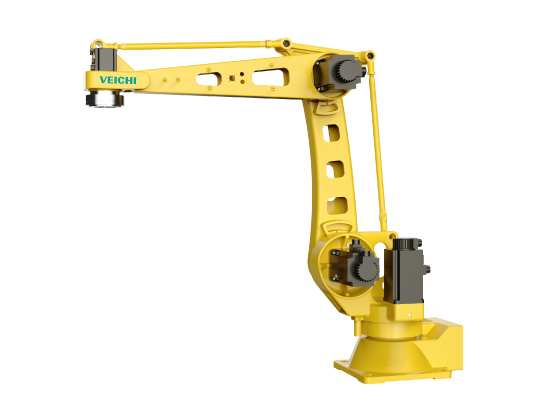

Four axis robots, also known as robots with four degrees of freedom, are industrial automation devices with four independently controllable axes. These axes typically include base rotation, shoulder rotation, elbow rotation, and wrist rotation. The design of four-axis robots gives them high flexibility and speed within a specific plane (usually horizontal), making them highly suitable for high-speed pick-and-place operations.
Lie in their simple structure, relatively low cost, easy programming, and high motion speed and repeatability in the plane. These features make four-axis robots very popular in industry applications requiring high-speed, high-precision operations.
In the electronics industry, four-axis robots can be used for the rapid and precise placement of small components, such as the assembly of mobile phones or circuit boards.
On automated production lines, they can efficiently move small workpieces or products, reducing manual intervention and improving the smoothness of the production line.
In the food, pharmaceutical, and light industry sectors, four-axis robots are used in automated packaging lines for product sorting, boxing, and palletizing.
Leveraging their high precision characteristics, four-axis robots can also perform tasks such as product appearance inspection, dimension measurement, and functional testing.