H6.5 Three-Level Topology High Efficiency Inverter for Solar Applications

H6.5 Three-Level Topology High Efficiency Inverter for Solar Applications

Vincotech China
  • H6.5 Three-Level Topology High Efficiency Inverter for Solar Applications
  • H6.5 Three-Level Topology High Efficiency Inverter for Solar Applications
Summary
The H6.5 Three-Level Topology High Efficiency Inverter for Solar Applications delivers superior efficiency with reduced switching losses and minimized filtering effort. Ideal for renewable energy systems, this topology decouples the DC link capacitor during freewheeling, lowering overall losses and enhancing performance. Featuring six IGBTs and five fast diodes, it ensures reliable operation in solar inverters, offering optimal power conversion with minimal voltage drop. Widely used in high-efficiency photovoltaic systems, it supports both real and reactive power management, making it a versatile choice for modern solar energy solutions.More
  • H6.5 Three-Level Topology High Efficiency Inverter for Solar Applications

The New H6.5 Topology

Three-level topologies' enticing benefits are twofold: high efficiency and reduced filtering effort. Several multi-level topologies for single-phase solar applications are already on the market. The main drawback of this two-level operation is that it requires a relatively large output filter and regenerates energy back to the DC capacitor during freewheeling. This regenerated energy flows to the inverter twice, which takes a toll on efficiency. Three-level topologies such as H6.5, in contrast, reduce filtering effort and switching losses.

Three-level topologies such as H6.5 uncouple the DC link capacitor from the AC output in the freewheeling phase to reduce overall losses.

The new topology uses six IGBTs like the HERIC topology, but it requires just five diodes.
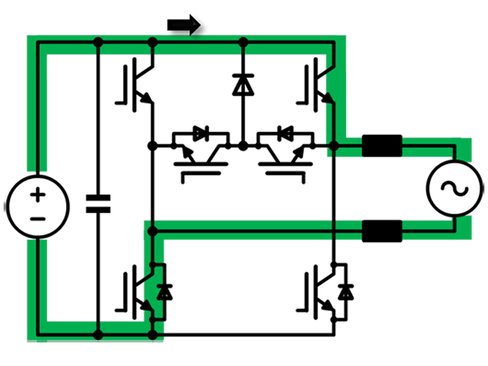
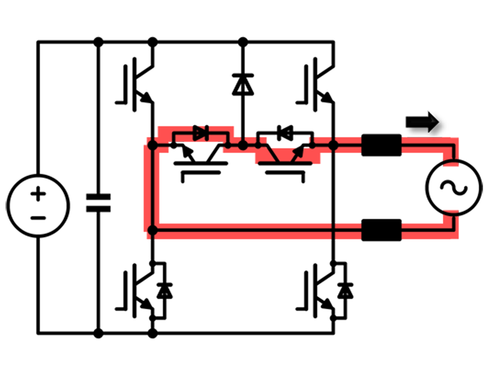
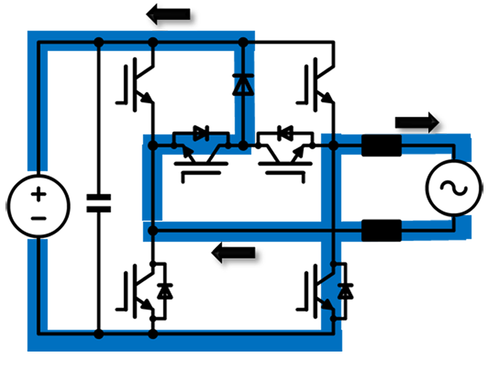
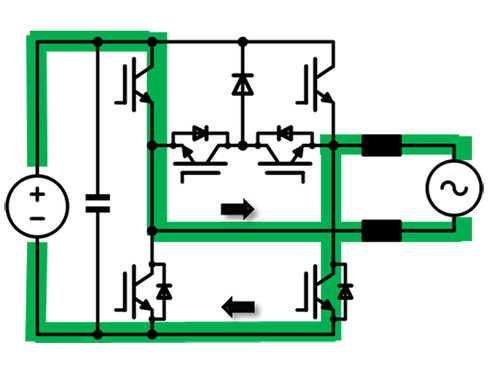
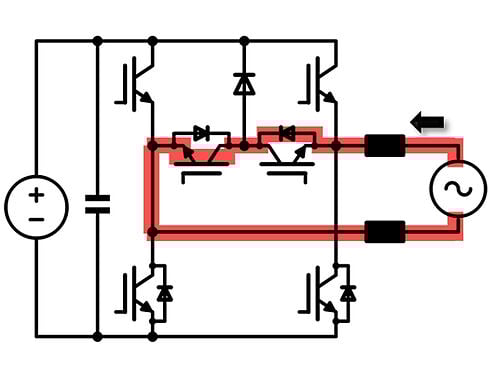
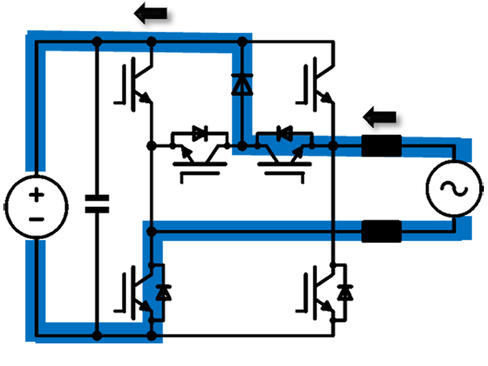
How the new H6.5 topology works:

positive half-wave

  • Real power - On
  • Real power - Off-Freewheeling / On-Reactive Power
  • Reactive power - Off-Freewheeling

negative half-wave

  • Real power – On
  • Real power - Off-Freewheeling / On-Reactive Power
  • Reactive power - Off-Freewheeling

Performance

The new topology achieves the same real power performance as the HERIC topology. There is a price to pay for reducing the number of diodes from six to five, namely one additional junction at freewheeling during reactive power. However, this is of negligible importance in solar applications.


Pros:

  • Voltage drop at real power during ON: two IGBTs
  • Voltage drop at real power during OFF and freewheeling: two IGBTs + two diodes

Cons:

  • This requires six IGBTs (four of the ultrafast switching variety) and five fast diodes.
  • Voltage drop at reactive power during OFF and freewheeling: three diodes
Download
REQUEST MORE DETAILS
Please fill out the form below and click the button to request more information about
Fill out the form below to make an inquiry
Company*
Country/Region*
FirstName*
LastName*
Business Email*
Whatsapp/Phone*
Your Request*
Verification code*
We needs the contact information you provide to us to contact you about our products and services.
If your supplier does not respond within 24 hours, we will connect you with three to five qualified alternative suppliers.
We use Cookie to improve your online experience. By continuing browsing this website, we assume you agree our use of Cookie.